

Preface
It has come to our attention that some readers, either from our writings or those of other Traditionalist authors, have some confusion as to the nature of the terminology that has been used by us and others in the past. One could hope that this would be ubiquitously understood information for those willing to engage with works such as these, but this is by no means the state of affairs, for even we ourselves had to do much work in our earlier years to arrive at the positions we have today. As a result, we wish to provide this article as a resource for people to help understand the implications that extend from the terminology under discussion here, as well as appreciate some of the fundamental underlying recognitions and positions that those of the Traditionalist School of thought participate in.
The three terms under consideration could be approached in multiple different orders, but we feel the best method is to assess these terms in order from start to finish: metaphysics, esotericism and universality. Some other terms may be necessary to fill in some gaps in between, but these are the three core terms that, while having different focuses, may even be used synonymously in some cases, as the object of their focus is the one and same Truth of the highest order. Once understanding of these terms is achieved, deeper truths may very well have themselves more readily manifest. So, without any further delay, we must delve into these necessary terms to facilitate and broaden understanding.
Metaphysics - Cosmogony vs Cosmology
That which can be properly termed metaphysics is the study of first principles, the fundamental aspects of existence. This often includes dialectic and considerations of the topics of being, knowing, cause, essence and substance, as well as time and space. These concepts warrant their own digressions, and, as such, merit their own delineation as to why such factors are of chief importance and interrelate with one another. Before such considerations can be undertaken, we must first note a bifurcation of focus in the realm of metaphysics.
The first and primary focus of Metaphysics is on issues of cosmogony, which is the science of understanding the cause behind the origin of creation. For moderns this is relegated to the existence of the physical universe, but for the world of Tradition this also investigates the existence of the spiritual and psychic domains of existence as well, also taking into consideration the source of all being ontologically which is Beyond Being.
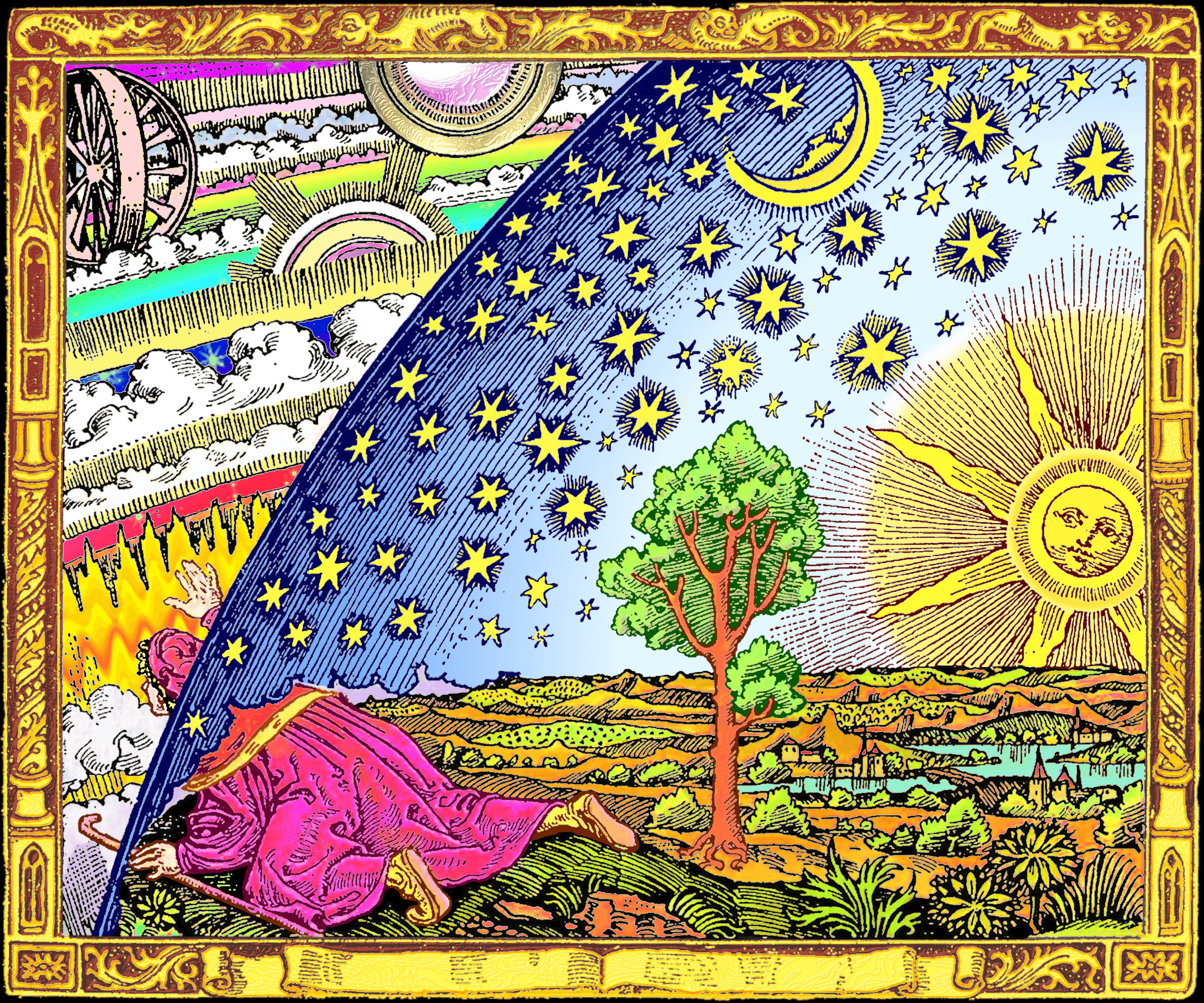
Nothing can be made manifest unless it is from the unmanifest, just as that which is created cannot come from anything unless it is uncreated. Just like one can’t engage in movement unless one pushes off against that which is unmoved, the same is true for the universe. This principle is reflected by the idea of the “Unmoved Mover”, or the hollow center of the axis of the wheel, the one that turns the wheel but does not participate in its movement, also referred to as the Primum Mobile, or “first mover”. This doctrine, though well understood by the Greeks, is also key behind the symbol of the Wheel of Dharma and the swastika in Hinduism, and it should be noted that the swastika shows up latently in all other major Traditions, in one form or another, as well, a key reflection of a topic that will be explored later.
The use of cosmogonic principles into specific applications goes into the realm of cosmology, which deals with the nature of the universe and under the purview of what Aristotle would have called physics, which is the study of nature and natural law, which later became indefinitely separated into all the various profane, or modern, sciences which exist today. It should be noted in passing that, since creation and existence is a result of God’s divine influence, all natural law is really an extension of divine law, since the latter extends from the former, though do note that there are higher laws than the cosmological factors behind our existence in the purely physical.
Due to the factors of modern degeneration, many people in the domain of “philosophy” will claim that not only is there no objective reality, as a result of post-modernist influences, but they go on to deny metaphysics entirely. This is a reflection of the paucity of their “intellectuality”, which is really nothing more than the domain of logic and reason, whereas true intellectuality is from the domain of the spirit, supra-rational and supra-individual, by which we mean divine in origin (see Rene Guenon’s Crisis of the Modern World, Ch. 2 “The Opposition Between East and West”).
Despite these modern considerations, cosmology, grounded in Traditional Metaphysics, allows for the application of universal knowledge in practical domains, better termed as Sacred Sciences, which are grounded upon eternal principles that are always immutable, as opposed to the profane science, i.e. modern sciences, which - either empirical or applied - extend from ever changing and mutable hypothesis, without any stable grounding, principles, or universal truths that would allow for its mode of praxis to have more efficacy and consistency. This lack of universal character within the profane sciences is also reflected by its multiplicity in focuses, indefinitely descending into a multitude of specializations and focuses that draw away from a more integrative whole of knowledge and more towards particularizations and erudition for erudition sake (see Guenon’s Crisis of the Modern World, Ch. 4 “Sacred and Profane Science”).
In all domains in which we live today in the modern/post-modern world, it appears that everything is founded upon that which denies the metaphysical, which of course is of the highest, or first, principles of all of existence, and, as such, much knowledge is disjointed and divorced from that which is higher than itself, and it is only metaphysics which can bring all knowledge and wisdom into an integrative and synthetic whole of eternal and immutable (universal) knowledge, which allows us to achieve a higher esoteric domain of truth. To expand upon such factors, we must continue further.
Esotericism - Esoteric vs Exoteric
That which is properly termed esoteric is that which is not easily knowable or is, by the nature of the degree of knowledge, obscure and not easily manifest. Etymological considerations will point this since “eso-” as the root word connotes that which is “inner” or “hidden”, and may even make evident a certain degree of secrecy inlaid within the designation of that which is properly esoteric.
To truly appreciate that which is esoteric, we must recognize that which is exoteric as a launching off point, since the latter is that which is lower and the former higher. Exoteric, properly speaking, is that which is outwardly manifest, popular, and understandable to the laity of society, evidenced by the root of “exo-” connoting “outward”. That which is exoteric is teachable and easily approachable knowledge, which of course leads to its popularization amongst the masses. One must first achieve a degree of exoteric knowledge before one is able to ascend to a higher mode of esoteric knowledge via realization, because that which is esoteric cannot be generally taught, communicated, or learned - which is why it must be realized inwardly via the individual’s supra-rational intellect, which, of course, is of a spiritual order.
The exoteric is often connoted by not only the color of silver but the silver key of the lesser mysteries par excellence, whereas the esoteric is connoted by that which is golden, the golden key of the greater mysteries. The same is true with the Janus Mask, with the older face relaying the exoteric and holding the silver keys facing towards what is past via reflection, whereas the youthful face, connoting the vivifying nature of the spirit, is symbolic of the esoteric and holds the golden keys that face towards the future and to eternity. The third face of Janus is, of course, hidden, that which is the present and is eternally so, since the present always and forever exists.
Relaying such esoteric symbology will obviously not be understood by all, just as Christ also spoke through parables with their own hidden symbols, but the Lord often said, “for those that have ears, let them hear”.
To take this a step further, that which is exoteric is reflective of the religious mode of the Traditional faiths, whereas the esoteric is the higher oriented spiritual practice within that faith that contains higher, hidden truths of a vivifying spiritual dimension. For Christianity there is Hesychasm, for Hinduism the Advaita Vedanta, for Judaism the Kabballah, for Islam there is Sufism, for Buddhism there is Vajrayana, the Chinese Tradition has Taoism and so on. Without the esoteric domain, the exoteric has no vivification, greater degree of presence, or ease of maintenance through transmission, which only leads to dissolution of the Tradition through time. Such sentiments are echoed when the Bible states the following:
“Who also hath made us able ministers of the new testament; not of the letter, but of the spirit: for the letter killeth, but the spirit giveth life.”
[2 Corinthians 3:6, KJV].
That which is esoteric is that which is metaphysical, since both deal with the same degrees of the highest of truths behind existence and being and, as such, must be universal everywhere, which brings us to our next point.
Universality - Eternal Being vs Contingent Becoming
That which is properly universal is that which is manifest everywhere and always true. By virtue of truth always being true, it is eternal and unchanging, immutable and of the highest order of Being, since it always is. Such a simple recognition reveals the superiority of the Universal, i.e. the Esoteric or Metaphysical, by virtue of its eternal presence, whereas any degree of knowledge in the realm of application, which is naturally contingent in the physical domain only and, as such, relegated only to the realm of becoming and change, is subject to change, revision, and dissolution.
We say that which is in the physical is in the realm of becoming, because things are always subject to change when they are limited by quantity/substance, whereas that which is eternal is pure quality/essence; the former is not self-sufficient, while the latter is self-sufficient, by virtue of its eternality. As such, this reveals the universal truth the essence is superior to substance, or quality is superior to quantity, and, to take this a step further, the non-material is superior to the material (see Guenon’s The Reign of Quantity and the Signs of the Times).
This reveals the universal, esoteric and metaphysical truth of the hierarchical nature of ontological existence, since essence can exist without substance, but substance cannot exist without essence. Essence and Substance are poles of manifestation, but the former necessarily is superior to the latter, just as Order is superior to Chaos, Love superior to Strife, and that which is Centripetal is greater than that which is Centrifugal.
The only way something exists is by participating in presence or Being, since, if it has no presence, it would have no being at all, physical or otherwise. This is why we must always view things in positive terms, as opposed to privative, since, for example, that which is evil is that which lacks presence or being, especially with regard to virtue, since vice is the privation of virtue. Just as substance only has presence with regards to its participation in essence, that which is modern only has truth insofar as it participates in the Traditional, and only insofar as we recognize that the Traditional is that which is Universal, Eternal, and Truth of the highest order.
There is nowhere where the truth is not manifest, and no place or people has a monopoly on truth of the highest order, for, as it has been said, “everywhere God leaves a witness.”
The Transcendent Unity of Traditions
For this section, we must heavily borrow from the work and phraseology of the Traditionalist Frithjof Schuon and his work The Transcendent Unity of Religions. In this work, it is recognized that, at the esoteric domain, all religions are not only true but that they also all agree with one another, because they participate in the same truths borne from revelation from above to below. They participate in some apparent contradictions at the exoteric domain, since all religions forms adhere to the culture and people of a specific time and place, but at the esoteric domain there is no conflict, since the source of all revealed Tradition cannot oppose itself. Although, it must be noted that some conflict can, in the present, and has, in the past, arisen, since every religion naturally strives to be the best that it can be, even at the expense of other Traditional societies, though concordance is found the longer these societies have communication with one another, and there is no greater point of connection and communication now than at any other time in human history. It is only natural that certain truths will become more manifest of this order over time.
For an example of how Tradition’s cannot truly contradict one another, there is the Trinitarian God in Christianity, whereas Islam focuses on only Allah. The latter focuses on the Divine Simplicity of God and His connection with all things, whereas the former does the same but in the understanding of the three modes of God, the Father, who gives all and receives nothing in His Absolute nature, the Son, the pathway to the Father and Ideal Man in His Universal nature, and the Holy Spirit, which makes all things happen through God’s imminence in his Relative nature. Despite any apparent contradiction, all exoteric recognitions are true from the esoteric point of view, but become limited when relegated to the purely exoteric of dogma of doctrine alone, the letter of the law.
To take this a step further, though the Trinity of Christianity is very much onto itself in the exoteric domain, there are Trinities in other Traditions as well, which relay the esoteric significance of the Trinity and three from a spiritual point of view. In Taoism there is Heaven - Earth - Man, with the former being the essence, the middle being the substance, and the latter being the reflection of both. There is also the Trimurti of Hinduism with Brahma the Creator, Vishnu the Sustainer, and Vishnu the Destroyer - the former like the Father, the middle like the Son who maintains but is also the Supreme Personhood, and the latter is like the Holy Spirit, though not understood in His purely immanent mode but more so in the mode of being the force behind all change.
All religions, i.e. Traditions, are absolutely relative, given that they are absolute, with regards to their participation in esoteric truths, but they are also relative to one another, with regards to their application to the religions forms they undertake to be understood as means of support towards helping achieve the esoteric domain.
One must imagine the esoteric as the peak of the mountain, the highest state that allows the ability to gaze upon all the vistas and sides of the mountain, the plurality of Traditions, that share in its apex. The peak looks the same from every side at the bottom, but only at the peak is the body of the mountain united, despite the apparent differences of each face of the mountain. It’s no surprise that the mountain serves as an esoteric symbol in multiple Traditions, due to these considerations (see Julius Evola’s Meditations on the Peaks).
We must recognize the esoteric as what is called the Primordial Tradition, that which was practiced by man in his unfallen state, in mystical union with God, and this is naturally the source of all other Traditions. It can be symbolized by the trunk of a great tree (consider the Tree of Life in this context), being the root for all the other Traditions which are its branches. One must note here, despite the essentiality of the esoteric over the exoteric, that one cannot live off of the bark of the tree (i.e. the esoteric alone), but, instead, off of the fruit of which the tree provides and sustains us from its branches (religious Traditions), which brings us to our next point.
Orthodoxy vs Syncretism - Tradition over All Else
By virtue of our last recognition, it becomes apparent that one must arrive at the esoteric from spiritual practice, extending from an orthodoxically oriented fidelity to only one of the plurality of Traditional faiths that exist. The fruits of the Tradition can only truly be enjoyed and harnessed at one of its branches, and from one branch only. So, not only can one not sustain oneself off of the purely esoteric without some degree of exoteric grounding, but what must also be recognized is that one should only practice one faith and not a multitude of them at the same time, as this would lead to what is referred to as syncretism, a blending of multiple orthodoxies of different faiths simultaneously in practice.
Syncretism is a spiritually dangerous endeavor. It’s one thing to have a depth of one’s faith that allows for the esoteric domain and to use this obscure spiritual knowledge to see concordance and non-opposition in other faiths, and it’s another to blend the faiths together into some amalgam of spiritual practices outside of their proper context. Imagine aligning your chakras while also praying the rosary, or increasing your devotion to Shinto kami while doing the Muslim call to prayer - it’s a veritable madness.
To blend one or more Traditions together is to make something new, divorced from Revelation from above and, as a result, it is a purely human creation, which is necessarily of a lesser and non-inspired, or, even worse, of a counter-inspired nature. This would be properly termed a psuedo-religion, a false conception of spirituality, like the Theosophy of Mme. Blavatsky, for example (see Guenon’s Theosophy: The History of a Psuedo-Religion). Voodoo and Santeria can also lay claim to this designation as well, on top of the Cult of Santa Muerte, among other concerning infra-human, i.e. demonic, tenebrous impulses which could lead towards that which is counter-traditional or counter-initiatory. Satanism/Luciferianism, Scientology, various other cultic movements trying to create a religion of the Anti-Christ - such are the issues at stake if Orthodoxy, Hermeticism (proper interpretation), and spiritual fidelity are not maintained in our times (see Fr. Seraphim Rose’s Orthodoxy and the Religion of the Future).
Not only does syncretism lead to these darker impulses, but it leads one to one’s own spiritual destruction. To base oneself on syncretism is akin to building one’s house’s foundation on shifting sand - with no solid cornerstone (orthodoxy) or grounding (faith in one Tradition) to orient oneself, falling beneath the sands or into the mire of the abyss. Conversely, if one keeps fidelity and practice to one faith, the opposite is true, that one can find stability, safety, and surety in the operation and Orthodoxy of one singular house of faith. If one is grounded in what is eternal - universal, esoteric, metaphysical - one can never go wrong.
It should be noted in passing that even though knowledge is good, faith is better, since faith is essential towards not only fostering a disposition for the Truth, but it is also necessary to achieve gnosis, knowledge of higher spiritual reality, in the first place, which is the highest degree of true knowledge.
Just as water is the source of life and, with regards to Christian symbological language, extends from above to below in an unending fount of inspiration and sustenance. Such truth sometimes may not be readily manifest as well, like a source of water underground. Hermeticism is the key to achieving depth in spiritual practice, so this vital elan of spiritual water can be achieved, both at the root and at the height. So, to go along with our previous focus on the essentiality of fidelity and orthodoxy, we will provide one further point to emphasize its importance:
“One does not gain water by digging ten wells ten feet deep, but by digging one well one-hundred feet deep.”
The Synonymity of Terminology at the Highest Point
With all these recognitions, despite all appearances, Truth is one and extends from the One. That which is esoteric is necessarily metaphysical, and that which is metaphysical is necessarily universal since it extends from the One. All of these divine names of Truth, One, Good, Being, and Love are all really names for the same Reality - God. Even so, God is even beyond these conceptions since He is the source of all conception, since all that is knowable is made manifest from the unknowable, all that is manifest comes from the unmanifest, and so on.
If one is a Traditionalist, in the proper oriented sense, with respect to these definitions above, one is necessarily a Perennialist as well. As perennial plants are always so, such is a Perennialist focused on that which is true, always and everywhere, and what could be truer than this than the Traditions themselves? So, a Traditionalist is a Perennialist and vice versa, though we don’t doubt that some will disagree with our reasoning, but such opposition and distinction is meaningless to us.
From the highest point of view, despite their specific focuses, Esotericism, Metaphysics and Universality all signify the same thing - knowledge of Divine Principles which are always and forever true. Once one achieves the height of spirituality, one cannot find opposition anywhere, since everything is unified to the One by emanation, and to the One everything returns. A circle is eternal, with no beginning and no end, and all the radii are equidistant and unified by the central point which is unmanifest.
We are certain that our words have fallen short, for some things cannot easily be communicated with language, but we hope that our distinctions have led to some degree of clarity, or at least a fascination and interest in the depth that exists within the realm of Tradition. The reader too can engage in such endeavors, but only if they put pride aside, distinguish that which is ephemeral from that which is eternal, and focus on that which is most essential above all else.
This piece, and your greater work, are always thought-provoking and truth-revealing.
Thank you.
I invite you guys to decode the movie As Above, So Below. It's a pure Masonic initiation, a mass ritual. https://substack.com/@rodrigopelayo/note/p-201747110?r=8i86it