

The Limits of Logic and Reason
As we have noted in another work (see our Transcending the Political), there are indeed limits to action, and action is necessarily lesser in hierarchy than contemplation, the latter allowing for participation in the spiritual dimension, with the psychic dimension of the mind acting as an intermediary. Not only this, but there are indeed limits to the rational mode of contemplation as well, mirrored by the fact that there are indeed limitations to what can be conveyed, with regards to truths, especially of the highest order, with the written or spoken word.
As Rene Guenon notes in his The Metaphysical Principles of the Infinitesimal Calculus, here paraphrased, every distinction is a limitation, limitation leads to separation, and separation leads away from unicity. Therefore, anything that is conditioned by any degree of limitation, systematization or that which is subject to rules is necessarily limited and lesser than what can be properly qualified as the “unlimited”, “infinite”, or “unconditioned”, which is, in reality, synonymous with the Divine, that which has the highest degree of freedom. As such, by virtue of being human, having a soul conditioned and attached to form and body, with a mind conditioned in tandem through consciousness, we are naturally limited and finite as individual reflections of the Divine Principle as an image of God, though not God Himself. We participate in Universal Man by being connected to God through this conditioning, with the Christian viewpoint having the connection to God the Father through God the Son borne from our hearts, understood as Christ Jesus - the True Man, i.e. ideal man. Thus, as a result of our condition, it is our station to know and strive with God to know Him and become one with Him, which is why the sayings that go as thus exist: “To be man is know”, and also “Know Thyself”.
Even Immanuel Kant in his Critique of Pure Reason recognized that logic and reason could only take us so far, and that the Categorical Imperative that guides conditioned individuals goes beyond and extends from beyond the individual mode. Logic and reason do not always come to achieve what can only be properly termed as “supra-individual truths”, or, rather, “divine truths” or “divine law”. Much of what is given through Holy Texts, properly so called, is, by virtue of this recognition, not “man-made” but more so “revealed”. Similarly, math was not created but, rather, discovered, simply because truth exists regardless of man’s ability to perceive or know it. Beyond this, as evidenced by Plato’s dialogue Meno with the theory of anamnesis, i.e. “recollection”, being in accordance with the Hindu doctrine of samskaras, all that is knowable with regards to truth is not really “learning” but “remembering” what was forgotten, and that all truth comes from within from a source greater than ourselves. If we are able to know something, it is because it already exists latently within ourselves, and true knowledge is never truly separate from us.
With these factors under consideration, everything in our human conditioned state is limited and has a degree of separation from the fullness of Divine Reality and realization of Divine Truth, as a consequence of the Fall from mystical union with God, and yet, by virtue of the immanence of God, either rationalized as the Holy Spirit or otherwise, nothing is ever really separate from God, since everything extends from God as the first cause, and Truth extends from this as well since God and Truth are the same. So, this begs certain questions. How does the conditioned strive towards the unconditioned? How does the conditioned connect to and receive revelation from the unconditioned? How does one come to know that which is beyond form and is unknowable?
The answer to these questions and more is found earnestly and simply through prayer, and not prayer simply towards achieving some temporal or personal end. The prayer that we’re referring to is “devotional prayer”, though the value of “intercessional prayer” is notable and still of great spiritual value. As such, further treatment of these considerations is required.
The Purpose and Results of Intercessional Prayer
Before getting into the greater core intention of elucidating the efficacy of devotional prayer, we must first consider intercessional prayer. What can be properly qualified as intercessional prayer is a plea to the divine for help, either for one or more individuals or simply for oneself, to one end or another. This is probably the most common understanding of prayer and ubiquitously known and practiced by many. In this life, we find much want and need, as a result of our conditioned and limited existence, and, as such, this naturally results in many petitions to the divine for assistance, since we are clearly not self-sufficient in ourselves — a quality only reserved for that which is truly eternal and unchangeable.
The way in which such pleas and petitions can manifest is manifold. People can pray directly to God Himself, to the Angels and Saints, to Buddhas of the past, to what can be understood as aspects of divine incarnation in “lesser gods” (which can also be understood as angels or “celestial hierarchies” from a higher point of view), and even to ancestors of the past. As to whom the prayer is for, subjects of prayer could vary, including but not limited to friends, family, oneself, possessions, animals, etc. and so on. As to what the prayer desires to achieve for the subject, the prayer could be for health, wealth, favor, providence, guidance, and all other manifold desired results.
Regardless of who is prayed to, insofar as they are of or extend from the divine, the intent is the same in intercessional prayer: to petition that which is supra-human for human causes. Regardless of who the prayer is for, the intent is still the same: that someone can be helped by the divine. Regardless of what is gained by the prayer, the intent is still the same: that help is attained.
Some may wonder if it is just to petition other manifestations of the divine instead of the Source of Divinity Himself, and the simplest answer is yes, but to do so in accordance with balance and recognition of higher spiritual principles. One can petition angels, saints, ancestors, etc., but only insofar as it is done with respect to the recognition of the supremacy and monistic unity of God in the context of the intercession of these eternal beings. Whether it’s a guardian angel or a past sage, these individuated beings, in a closer unity and oneness with God, still have agency with respect to God’s will. So, to issue prayers forth for intercession to that which has agency is blameless, insofar as the devotion towards these beings does not go above the devotion that is reserved for God alone.
Others may wonder if it is just to pray for others, or if prayer from others is even necessary or efficacious, since we as conditioned individuals do not have the means to actuate such favor in and of ourselves. To answer simply, we are all intended to be agents of the Divine Will in this life, and, as such, our actions are not without meaning or consequence, just as existence implies duty and purpose. Just as Christ had his disciples, Krishna had Arjuna, the Prophet Muhammad had his followers, and many more examples — none of these great agents of the Divine Will did anything alone. To share and strive together in the Divine Mission is good and just, for everything extends from and returns to the One, and there is no true separation from one another from a spiritual point of view.
So, to wish another goodwill for one reason or another can only be a good, for it is likened to wishing oneself goodwill, and the love of God is what bears this out in practice. As the Lord Himself tells us in the Book of Matthew in the Two Great Commandments: “‘Love the Lord your God with all your heart and with all your soul and with all your mind’”, and also, “Love your neighbor as yourself.’ All the Law of the Prophets hang on these two commandments.” [22:37-40].
When loving God in the fullness of one’s tripartite being, just as God is tripartite in his Trinitarian unicity, in the image of God by being one with Him, this naturally leads to the love of one’s neighbor who is also an image and child of God. If one would want oneself to be prayed for, how much more ought we to also pray for others in tandem, since we should love them as we want ourselves to be loved by God and others. To do so will lead to loving neighbor and enemy alike, for there will be no true enemy for one that recognizes the fullness of the precepts of these spiritual laws. Also, the lack of enemies not only extends from the shared will of prayer for others and oneself but also from wanting all to achieve salvation, since one should never wish ill will on others, and nothing could be more ill than eternal self-imposed isolation from God in the depths of the reality of spiritual hell and eternal despair. As it turns out, we have a deep responsibility to pray and strive with others to the collective end of being one with God.
We must also add that, even though every prayer in this regard may not be directly answered on part of the exact will of the petitioner, every prayer is heard. There is a great comfort in this knowledge.
The Purpose and Results of Devotional Prayer
In continuation towards achieving the end of the oneness of God, as previously stated, no amount of logic or reason, as well as any experience or temporal good for that matter, can realistically bring one closer to the fullness of spiritual realization of God. This is understood in tandem with the phrase, derived from Christ responding to the Pharisees when they asked Him when the kingdom of God would come, when the Lord said thus: “The kingdom of God is not something that can be observed, nor will people say ‘Here it is’ or ‘There it is,’ because the kingdom of God is within you (or in your midst).” [Luke 17:20-21, italics mine]. So, not only is the kingdom of God shared between us as people as we strive together in earnest love for one’s neighbor and oneself in God, but also that God is within our hearts through our personal connection and act of sustainment by Him, since nothing exists without God since God is Being, Good, and the source of all Reality.
The only way towards the fullness of the spiritual realization of the Divine is inward — not through any physical technique or practice, not through any degree of intellectual exercise, though each of these things do help towards fostering the path towards God — through the spirit, i.e. the supra-individual intellect, the seat of which is to be understood as the heart. The easiest and universally applicable pathway for everyone to do so is through prayer, specifically devotional prayer, which is prayer towards reaching a closeness with God through love and loyalty to Him.
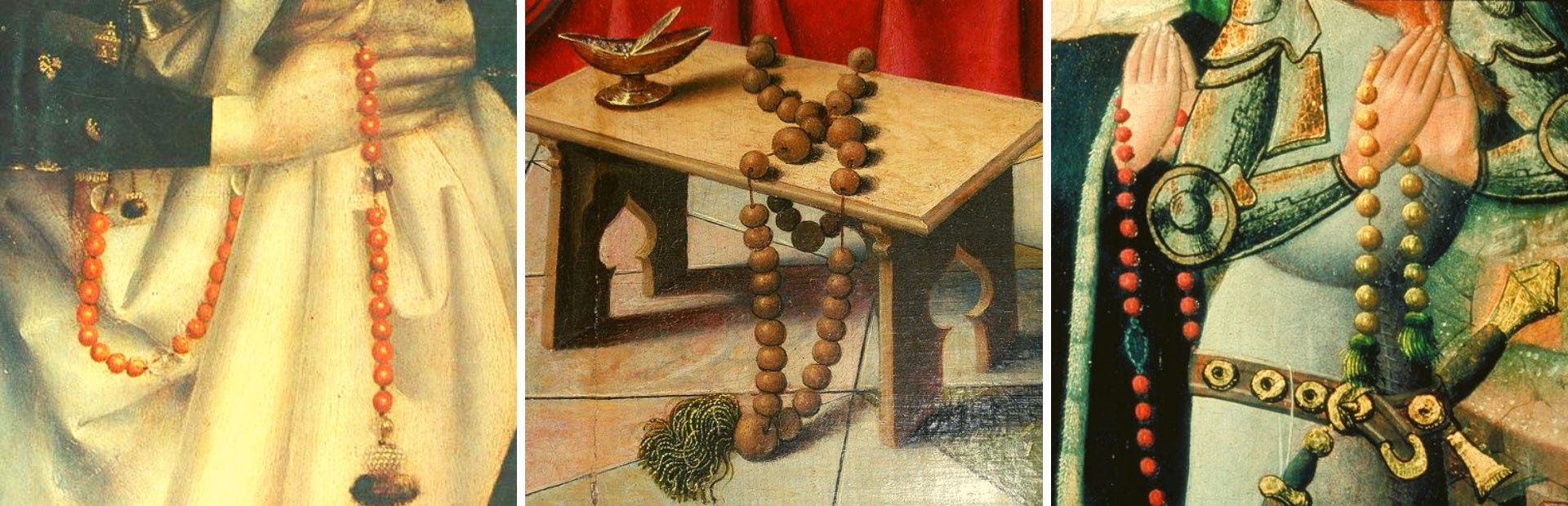
The way that devotional prayer looks is different across Traditions, naturally, but the core as to how it is performed and what it achieves is unified in principle. For Christianity, there are the 5 decades of Hail Mary’s and 6 Our Father’s prayers of the Holy Rosary, as well as the indefinite number of recitations of the Jesus Prayer of Hesychasm. There is the Om (Aum) of Hinduism, with its repetition fostering oneness with the Divine. There’s the invocation of the names of Allah for the 99 Dhikr beads in Islam. There’s the Mala prayer beads to reflect on the 108 worldly desires of Buddhism. While the latter is an act of devotion towards achieving the purely unconditioned, i.e. Nirvana, the former examples are all invocations of the Divine or the Divine Name towards not only remembrance of the presence of God, but this remembrance fosters love, devotion, and praise of the Creator towards the end of seeking unity with Divine Reality, as stated above.
The sacred science of numerology must be taken into consideration as to why the number of certain beads is important. For example, the 5 decades of the Rosary reflect the 5 aspects of the will, which are also represented by the 5 points of extension of the human body as follows: the will to take possession - right hand, the will to hold possessions - left hand, the will to conquer - right foot, the will to hold land - the left foot, and the will of the intellect - the heart. These 5 points form the upward pentagram, which is symbolic of man, and is also used, in tandem with the 6 pointed Seal of Solomon, for protection from demonic forces, considering the fact that the Rosary is often used for this purpose as well to “seal off” or ward off evil.
All these 5 aspects of the will must be crucified, just as Christ was crucified for our sins, because we must crucify our individual will so that we may align it with the Will of God Himself, the only true actor and Supreme Personhood. Certain aspects of these truths are revealed by the Tarot Trumps IV - The Emperor and V - The Pope. In the former, crucifying the wills symbolized by the hands and feet — evidenced by the Emperor being immobile by crossing his legs and leaning, as well as his hands fixed upon his belt and the rod of temporal authority — allowing for the control of one’s will with respect to the empire of the world around us, but the latter — with the Pope pointing to the heart — reveals the fruit of the full crucifixion of the will leads towards the potency of Divine Authority of the human will unified with the will of the Creator (note the seven pointed cross in his left hand).
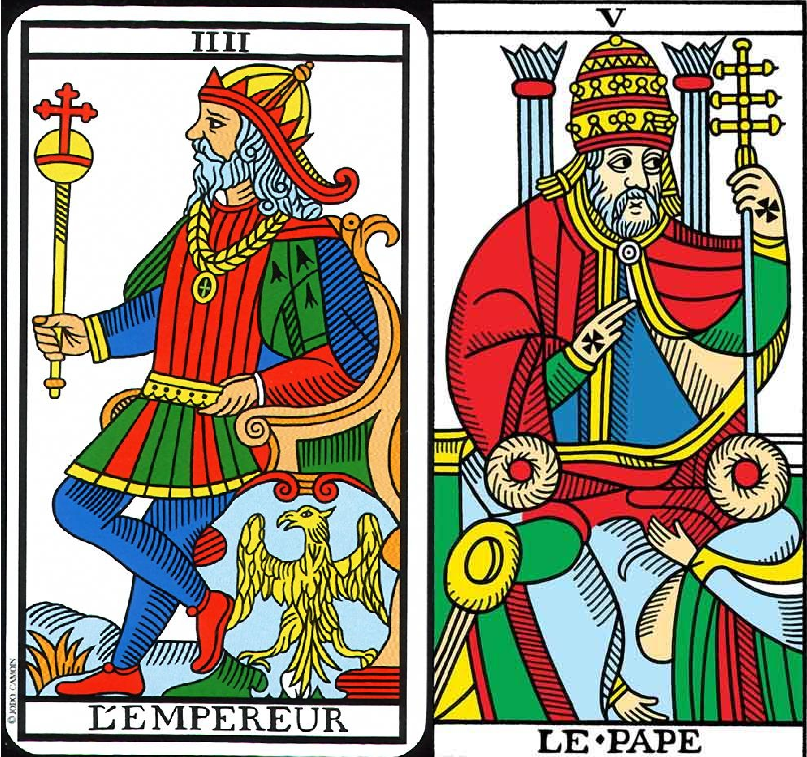
Additionally, the 5 decades of the Hail Mary are indeed sets of 10, with 10 being symbolic of temporal order, to be understood in conjunction with the importance of the aforementioned Tarot Trumps above (see our The Esoteric and Cosmological Significance of Four). The Rosary is also meant to be prayed in three different forms, with the Joyful, Sorrowful, and Glorious Mysteries meant to be prayed and contemplated to appreciate the different aspects of Christ and the Virgin Mary through the birth, death, and resurrection of Christ respectively — with three being significant for apparent Trinitarian considerations (the Joyful, Sorrowful, and Glorious Mysteries can also be understood as the process of “descending realization”, “ascending realization”, and the achievement of spiritual realization respectively, in accordance with the three dark nights of the soul, as per St. John of the Cross). As for the 6 Our Fathers, 6 is also a multiple of 3 and 2, with 6 also being reflective of the 6 days of creation which were lead to perfection on the 7th day, the Lord’s Day which is the Sabbath, which is part of the reason why priests move the censer towards the altar 6 times, with 3 sets of 2 motions, with the presence of Christ being the ever-present 7th element of perfection within the consecrated space (note in connection with the cross in the hand of V - The Pope above).
The significance of the 108 Mala beads goes beyond our realm of expertise, but the 99 beads of the Dhikr in Islam do provide some insight. In particular, 99 is a multiple of 3 and 33, with some Dhikr bead sets only having 33 beads as well, or also of 9 and 11, with 9 being a product of 3 times 3, and 9 having significance not only for Dante Alighieri with regards to Beatrice and other factors (see his Vita Nuova and The Divine Comedy, in tandem with Rene Guenon’s The Esotericism of Dante for more information). With regards to the significance of 11, it is just short of 12, with the latter symbolic of celestial order, evidenced by the 12 disciples, 12 knights of the round table, 12 astrological symbols or archetypes, and so on, with the additional 1 added to 11 being of the Divine Element. We will also note that Christ was 33 at the time of his crucifixion, and that there are 33 vertebrae in the spinal column of man, a natural sign to be taken in tandem that man also has 12 ribs to add for his support, reflecting the sign of the cross in the Divine vertical dimension in conjunction with the horizontal dimension of heredity. As for why 99 is significant from the specifically Islamic point of view can be explored another time.
Returning back to our primary objective, all devotional prayer is indeed unified in principle, simply as a result of constant spiritual direction of the will towards that which is “above”, in a spiritual sense. Without any further equivocation, it’s really as simple as that.
If one cannot achieve a certain action, or ascertain a certain contemplative pursuit that fosters spiritual practice, prayer is the way for these truths to be revealed over time. No amount of dialectic or reasoning will convince anyone who is opposed to such precepts that this is the case, as it is more so reflective of the lived experience of all the saints and sages that are, have been, and will come to be. If one does not have faith in what cannot be witnessed, then no work can follow, and work without faith is meaningless. Faith can also be understood as “philosophy”, in its original etymological understanding extending from the Greeks, simply as the “love of wisdom” or the disposition to want to know. If one doesn’t know but wants to know, that is all that is necessary to come to know. If one does not wish to know and simply to critique, then one may never come to truly know what is to be achieved through spiritual discipline.
Prayer is to that which is supra-individual, and it is with that which is supra-rational that one achieves this, because the Divine is the source of all that is and, as a result, is also above all that which is. One does not achieve the unconditioned by the conditioned, but can only achieve the unconditioned by the unconditioned. Conversely, the only way to truly know God is to become Him, and the patience and humility fostering the presence of the other virtues within the soul of the individual through constant devotional prayer is the best way to achieve this.
For additional considerations of the unknowability of God through conventional means, one only need look at the Mystical Theology of St. Dionysius the Areopagite (psuedo-Dionysius for the moderns), which refers to the One True God as hiding in “Divine darkness”, and to the process of “ascending realization”, by which one denies all names attributed to God, because God is the source of these names and is beyond them in his Transcendence. There is also the anonymously written The Cloud of Unknowing by a Christian monk that refers to “the God that hides in darkness”, and that one needs to use their prayers as “arrows upward” in chanting the Divine Name unceasingly to arrive at a state of the eponymous “cloud of unknowing”, by which one forgets everything and sits in silence with God. This is similar in tandem with St. John of the Cross and his Dark Night of the Soul (see our Solitaire, the Tarot, and the Three Dark Nights of the Soul) with reference to the second dark night, by which one goes into profound spiritual darkness, experiencing the unknowability of God and having to go by faith alone, as the unknowability of God becomes fully realized inwardly, transitioning to the third dark night in which God is revealed to the heart. Take this in consideration with the three stages of initiation as well, with purification, illumination and perfection being achieved inwardly through the rites of baptism, confirmation and communion respectively, also with respect to the significance of three numerologically.
The Methodology of Prayer and Conclusions
Repetition is key. Through reflexively and constantly praying, one achieves a harmonious inner state that is free, or freer, from distraction. As Thessalonians 5:17 tells us, the key focus of The Way of the Pilgrim which focuses on the efficacy of devotional prayer, one must “pray unceasingly”. This has been a conundrum for many, including the anonymous author of The Way of the Pilgrim, for to do such a thing runs counter to the lived experience of people in the world with so much to draw their attention away from prayer. Therefore, we must explore what it means to pray unceasingly.
Everything one must do to devote oneself to the Divine must be with respect to mindfulness of the ever-presence of God, within and without, is the constant remembrance of Him at all times. This can be through the act of intercessional prayer, devotional prayer especially, but this can also be through actions that are in service to this mindfulness of God. Even the act of writing on Him or speaking of Him — in accordance with His Will, with the actuation of Divine Magic or “Thaumaturgy” — can be considered prayer in this context. Reading inspired texts, like the Bible or works of Saints, is also valid and necessary in this context for the fullness of spiritual practice towards the end of this remembrance.
Similar considerations can be seen in Hinduism and Buddhism with the use of mantra in contemplation and the concentration necessary for asceticism in prayerful meditation. In the Pali texts of Buddhism in particular, certain phrases and discourses of the Buddha are purposefully repetitious towards the end of fostering this mode of supra-rational meditation. The same can be said for the Vedas, which often repeat certain phrases or actions in the recitation of various portions, especially for fostering connections of esoteric doctrines evident in the Upanishads (Upanishad = “hidden connection” = esoteric, with translational and etymological considerations taken, with that which is esoteric naturally being obscure and “inward”).
Even though quality is superior to quantity, quantity of prayer is important to foster quality of prayer. Through an indefinitude of quantitative actions, quantity ceases to be important with respect to the quality derived from the actions themselves. It may seem dry and unimportant as to how often certain prayerful actions must be taken to those with a lower, limited point of view, but to those whose eyes are on the eternal such actions are of paramount importance towards remembering the True Self.
With prayer revealing God within the heart, a story from the Kabbalistic Tradition comes to mind in this context, that of the King in the Center of the Castle. In the story, there is a King who is in the center of the castle, but there are many walls and corridors built around him so that he is inaccessible by his servants. The servants search in vain throughout the castle, unable to find and serve their King. However, the Prince intervenes (understood as the Messiah, specifically Christ from the Christian point of view) and shows the servants that many of the walls of the castle are false, and that the separations between them in the King are not only truly few but, ultimately, illusory — the King was never truly separate from them. For our purposes, our understanding should be thus: only through inward prayer and devotion does Christ within us reveal all that can be revealed by illuminating us to God’s presence within.
So this will undoubtedly bring a question from many: how can the average lay person achieve such a thing, with all the difficulties, duties, and considerations in everyday life that take us away from the fullness of this prayer? The answer is that every person must make their own choice as to how they choose to live with regards to spiritual practice. Not everyone can be a celibate priest, nun, monk, or person of high religious station, but as the Lord tells us in Matthew 19:11 - “Not everyone can accept this teaching, but only those to whom it has been given.”
Everyone can pray, but not everyone has the capacity to live the celibate lifestyle of a true saint, though we are all called to be as holy as our capacity and devotion allows us to be. With regards to spiritual practice, always remember: forgo that which is good for that which is better. Though reading texts in devotion to the Divine is good, just as intercessional prayer is good, devotional prayer is better, for what the latter achieves is greater than the two former, since devotional prayer is supra-individual in its goals and achievements. Everything must be in balance with respect to one’s person, in the context of who they are to others and the world around them. It is easy to speak in generalities with respect to universal truth, it is another thing to tell every discrete individual how best to apply that universal knowledge to themselves and their vocations. The discernment of the individual and their spiritual director are best to consult, with the grace and guidance of God, should be first and foremost in this respect. So, if one has the opportunity to pray, or has the ability to make time for prayer, considering how important it is and ought to be to the individual, one should always do so when able.
Still, to quote 2 Timothy 2:19 - “The Lord knows those who are His.” God knows what is in our hearts, for He is there. God is not only the Transcendent Good and Source of Being, but he is also the Transcendent Justice, and He can never do anything that is not in accordance with Justice which is Himself. Insofar as one knows that they are right and just with their connection to God, one will naturally turn away from that which is sinful and unjust, and one will do that which is best with respect to themselves and others. To discern and know what is best, to foster that connection with God in the heart, all one needs to do is pray, bringing our considerations to a close.