

Initial Recognitions and Core Story
This article will no doubt perplex some of our readership and people that share our dispositions, but anyone with a higher orientation towards spiritual principles sees the sacred in all things, and, to think otherwise, is merely reflective of the profane point of view, which is really a privation of a fully realized metaphysical point of view. This aside, the story of The Sandlot has much to show us and allow us to reflect on its esoteric dimension. Whether or not these elements were intentional or unintentional by the writers and makers of the film is completely secondary to the universal aspects that are within.
The story takes place in the San Fernando Valley of California (though, oddly enough, filmed in Utah) in the summer of the year 1962, in the tail end of post-war optimism and so-called “Age of Affluence”. In this landscape of American suburbia, the main character of Scotty Smalls moves in towards the end of the school year, without much ability to make friends, which is exacerbated by his rationalistic and bookish tendencies that hamper his ability to make personal connections with others. His unathletic tendencies prevent him from having the confidence to even catch a baseball, let alone throw one. Smalls also has a tenuous relationship with his step-father, Bill, who loves baseball, but the lack of shared common ground maintains their distance, resulting in a very awkward, and painful, game of catch.
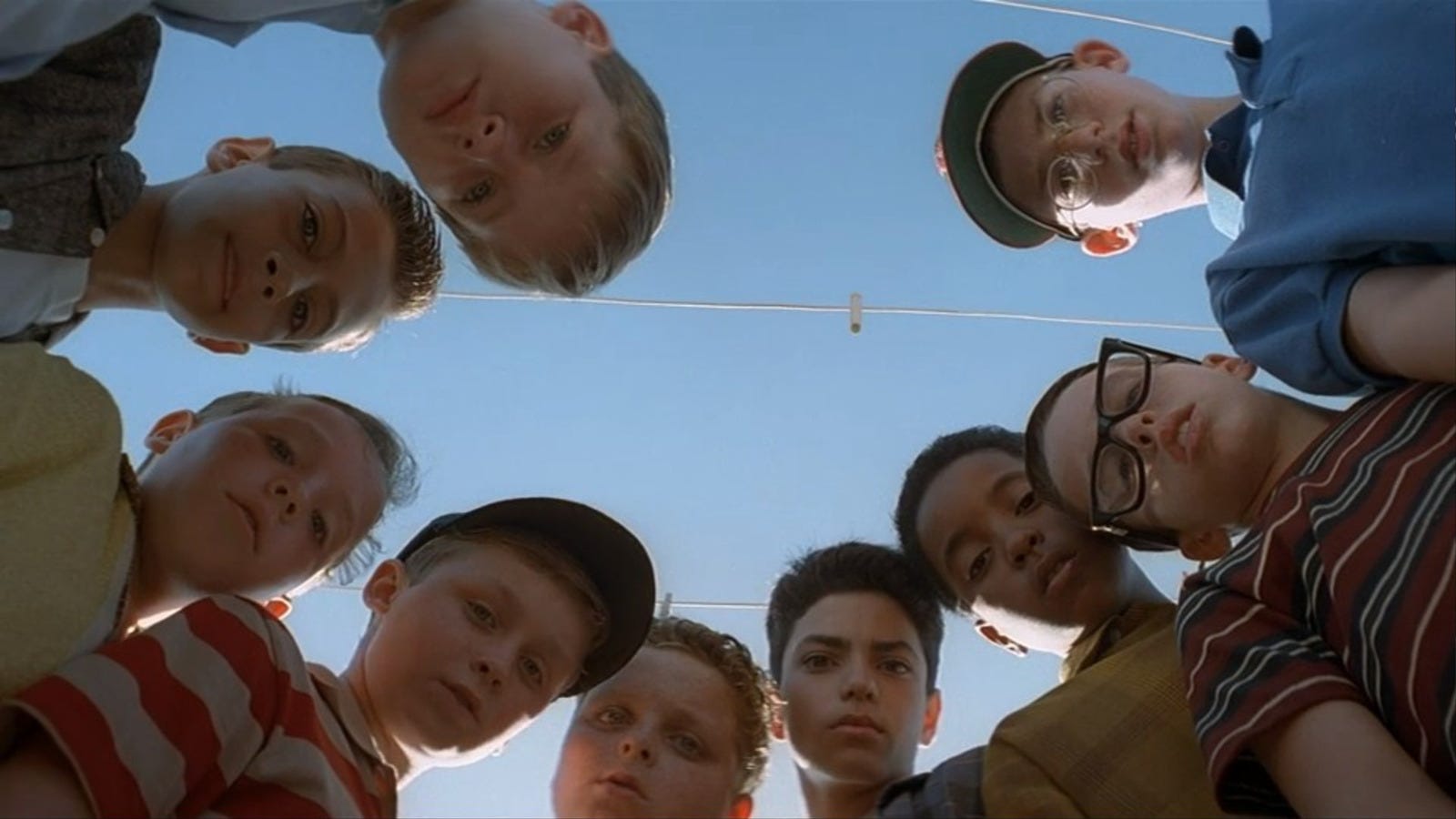
This is where the movie shifts and centers around Smalls relationship with the ring-leader of the Sandlot, Benjamin (Benny) Rodriguez. Benny invites Smalls out to the field, which Smalls tentatively accepts, and, after some relative embarrassment, coaching, and a well-hit baseball by Benny, Smalls comes to be accepted into the group, despite his lack of knowledge about the game, as well as not knowing of the famous Babe Ruth. The other characters of Hamilton (Ham), Michael (Squints) Palladorus, Kenny DeNunez, Bertram Grover Weeks, as well as Timmy and Tommy Timmons provide important and supporting roles in the group dynamic as well, and will be mentioned as necessary.
Meanwhile, on the outskirts of the sandlot past the outfield, Mr. Mertle’s junkyard looms with the dangerous and elusive Beast — a dog so large that is rumored to have killed and eaten robbers, as well as children — which is just on the outside of the game, adding a layer of mystery and danger that will be explored in greater detail later. The Beast not only, supposedly, consumes children but mainly baseballs, so any ball on the other side is, naturally, assumed to be lost for good.
Naturally, hijinks ensue in a relatively standard fare of a film centered around coming-of-age mores, and there are many events of note. There’s when Squints, aged 12, fakes drowning at the public pool to have the older lifeguard, Wendy Peffercorn, aged 16, to save him so that he can steal a kiss from her, much to her ire and chagrin. There’s plenty of baseball games in between during the day, and even a memorable game on July 4th under a slew of fireworks illuminating the night sky. The Sandlot gang win a challenge game against the local Little League team, putting the more official “high and mighty” boys in their place, which is followed by a rather embarrassing celebration at the local fair when Bertram gives all the boys chewing tobacco to enjoy on the “tilt-a-whirl” style carnival ride — without a spit cup, mind you, causing them to swallow the tobacco juice — causing them all to throw up on themselves and others in the vicinity of the ride.
This is where we will leave our summary for now, for we must relay the significance of the culmination on the film towards the end of our exposition, which first requires an expansion on important esoteric factors about the movie worthy of consideration for our purposes, as well as to draw a fuller picture of all the elements at play within.
Freemasonry — America — Baseball
Since this is a quintessentially American film, and Baseball is America’s pastime sport, it should be of note that America, in and of itself, was not only founded by prominent Freemasons, of which George Washington, Thomas Jefferson, and Benjamin Franklin participated, just to name a few — as well as many others that came after like Albert Pike being of note — but another prominent American Freemason, by the name Alexander Joy Cartwright, was chiefly responsible for formalizing the contemporary structure and rules of modern day baseball. As a result, baseball as a sport heavily borrows from Freemasonic symbolism, imagery, and overall influence. Many prominent Freemasons also came to be major baseball players in the early days of the sport, which is only natural considering this occurred in America, where the extent of Freemasonic influence has already been stated.
Let us say, first and foremost, that there is indeed an esoteric and initiatic character involved in Freemasonry, given that it was founded as a result of the craft initiation of masonry, i.e. “operative masonry”, and what Freemasonry is now is not only “speculative masonry” but also a poor reflection of a more fully realized esoteric organization that existed in earlier time periods. Rene Guenon thought as much when he published his articles that would be compiled into his Studies in Freemasonry and the Compagnonnage (a great resource for a more full exposition), as well as being part Freemasonic circles and even founding a Lodge in France by the name Le Grande Triade which still exists today.
The key reason as to why Freemasonry, in today’s day and age, becomes suspect in various discussions and circles is due to the fact that various anti-Traditional influences were absorbed by the Freemasons of various time periods. When the Knights Templar, another initiatic and secret esoteric organization, was outlawed in 1307, much of their membership and influences found a new home in the Freemasons, and the same could be said for the Illuminati, which were disbanded towards the end of the 18th century and also found refuge within the Freemasons. As such, certain aspects of “New World Order” agendas from the latter, as well as some concerning practices from the former, would come to bear out in Freemason’s moving away from their more so higher intentions towards spiritual realization and properly oriented initiatic transmission. This in tandem with the foundation of the English Rite, as opposed to the Scottish Rite, in 1717 would lead to a further falling away from the original principles of both earlier speculative and operative masonry initiation.
Regardless, Freemasonic symbolism is indeed present within baseball. Whether it be with its focus on 3’s, with three major tiers of initiation being formalized into 33 degrees, being evident in the 3 strikes and 3 outs, as well as the 9 innings, with 3 x 3 = 9 (the number 9 was also significant to Dante with regards to his esoteric dimension). The symbol of the diamond is also central to Freemasonry, with their symbol being the intersection of the Builder’s Square and the Compass forming a diamond, both of which being tools of the trade of masonry, with the diamond symbolic of the realization, or crystallization, of higher spiritual states, very similar to the Vajra of Vajrayana Buddhism, with the Vajra being both diamond and lightning, symbolic of divine authority and power.
To go a step further, everything from home plate outward, from the perspective of the umpire, goes outward in the shape of an open triangle, the triangle being of a particularly great significance in Freemasonic symbolism, with the head of the triangle being reflective of the outward emanations from the so-called Grand Architect of All, which is God Himself. The third part of the triangle is missing, similar to the absence of Hiram Abiff, as the legend goes, with three grand architects being needed to transmit the three key initiatic degrees, supporting each other and manifesting the communication of the Tradition.
In the context of the film, these esoteric aspects hold little importance on its narrative. However, architecture implies structure, and structure implies order, and order can indeed be imposed by the act of the game. The game of baseball itself, a a mirror of an ordering principle — just as anything of a divine origin is indicative of order, structure and hierarchy — binds and orients its participants together through the act of sport, just as baseball was the binding principle for the boys of the Sandlot. Further considerations on the significance of sport will be explored later, but the game of sport is not the only “tie that binds” under consideration here.
Chivalry, the Lofty Goal, and Transgressional Lows
The character of Squints and his love for Wendy Peffercorn, though somewhat off-putting to more modern sentiments, has some interesting aspects for our considerations as well. First one must note the age difference between them, with Wendy being 4 years (at least) Squints senior, as well as the fact that Squints himself is on the cusp of manhood, not quite a boy and not quite a man either.
This film centers upon various rites of passage from boyhood into transmuting oneself into a higher state of what can be reflective of a man ought to be. Does the movie actually accomplish the realization of the truly noble spirit of man from a Traditional age? — No. Still, the echoes of what manhood is and ought to be made manifest in more recent ages point to the existence of more fully realized states and inner orientations that existed in forms of man that were closer to the Principle of manifestation in earlier ages.
With regards to the Chivalric Tradition, the longing for the maiden fair, secluded and lofty in her tower, is a key archetype in the Western Medieval world, symbolic of the Divine Feminine, either to be understood as Wisdom (i.e. Sophia), the Cardinal Virtues of Faith, Hope and Charity (Love), or even like in Kabbalah as for the feeling of the Creator, Shekinah, symbolized by a beautiful woman in radiant splendor. Love can be a transfiguring influence towards spiritual realization and higher states, and this initiatic disposition is best shown in detail via Julius Evola’s Eros and the Mysteries of Love: The Metaphysics of Sex for a fuller treatment for those interested. Similar dispositions were expressed by Dante, especially via his participation in the Fedeli d’Amore, another initiatic group of great import with ties to the Rosicrucians, being of the Rose Cross and extending from Christian Rosenkreuz, with the rose being symbolic of the heart in the West, and the heart being the seat of the intellect and of the supra-human principle.
All this taken into consideration, Wendy Peffercorn in her ruby red lipstick, hair tie and swimsuit, sitting atop a high lifeguard tower, aloof and unapproachable, with her shades obscuring her eyes — the window to the soul — from sight, such an image conjures such esoteric sensibilities to the forefront with regards to the chivalric ideal. Squints, of course, in the context of the film, desires after that which is lofty and higher, and, after some peril, achieves but a glimpse. Although, flashing forward to the end of the film, its revealed that Squints marries Wendy Peffercorn and has 9 children with her, the number 9 not being beyond our notice, the significance thereof as stated above, though I think the choice on part of the writers was more than likely subconscious in this regard.
As revealed in the above scene, the unfortunate element is the nature of transgression within the film, which is only eventual that boys will push the boundaries of what is acceptable. This comes down, to a certain degree, to the modern focus on individuation, borne from humanist principles of the current age, especially in the want to “stand out” or “set oneself apart” from others. The other side of this coin of transgression is to bring forth the will towards what it is that one desires, though not all desires are of a higher orientation, of course.
Part of this element of transgression is evident not only in the scene at the pool but also in the scene with the baseball game against the Little League team. Though the prowess and skill of the Sandlot gang is greater, they also use psychological warfare against the other boys, both insulting them and insinuating suggestive things about their family members, which is, once again, what most boys do. Its no coincidence that this air of transgression is continued in the scene afterward when Bertram gives the other boys chewing tobacco at the fair, which has a distinct carnival-like atmosphere.
The term carnival, derived from the Latin carne vale meaning “farewell to meat”, is reflective of feasting, excess, and relative revelry, though usually in the context in preparation for Lenten season but can also be emblematic of a seasonal decadence that happens in the change of seasons, with larger degrees of excitability taking place in the summer time and the greater heat inflaming the passions. Given the irrationality of the passions, it will naturally bring forth a more chaotic and tenebrous character of thoughts and actions that usually run counter to our higher nature, which can lead to a relative inversion of roles in which children can have supremacy over adults, in which Halloween is a prime example as well.
These thematic elements of the passions, transgression and inversion bearing out in vice bear out in the chewing tobacco, culminating in the scene with the vomiting off of the tilt-a-whirl while the song “Tequila” plays in the background. It reminds one of when St. Augustine in his Confessions relayed how he and some other boys had stolen into a pear orchard to steal the fruit, all to destroy it and feed it to pigs, all for the thrill of the transgression itself. Do note that St. Augustine relayed that he would never have done it if he were alone, revealing the nature of group dynamics predisposing one to vice, because most men would agree that they would do some things “with the boys” that they would never do otherwise.
Omens, Dreams, and Slaying the Dragon
After the revelry mentioned above, the step-father of Smalls goes on a business trip out of town and names him the “man of the house”, a title of relative renown, especially in earlier times. Smalls, of course, quickly squanders such responsibility in the most embarrassing fashion soon to come, but a great event intervenes to lead him to this decision.
One must note that there are always signs of Divine Providence all around us, but one only need the eyes and the intellect (spirit) to see them. Certain events may be portents of greater things to come, but such portents can also be reflective of greater dangers as well. Not too long after Smalls’ step-father goes out of town, Benny hits a baseball at the Sandlot so hard that the cover of the baseball is removed, revealing the inner part, the so-called “guts”, of the ball for all to see.
The husk of a seed, just as the outer cover of a baseball, can be relegated to that which is exoteric or simply the “outer layer” of that which is manifest, whereas the kernel itself is that which is inner or, rather, esoteric, given that it is hidden and not manifest. To bring forth that which is hidden to the light can be recognized as the revealing and realization of something greater, whether it be of truth itself or of higher states of being. So, the removal of the cover of the baseball is analogous to such symbolism.
This event in and of itself is the impetus that drives the Sandlot gang to demand another ball, since it seems that 99 cents USD in 1962 ($10.71 c. 2026) was hard to come by for the average pre-teen back then. Smalls, naturally, chooses to take the prized ball of his step-father’s signed by the legendary Babe Ruth (Smalls still not knowing the significance of who that is) and brings it out to play, all for him to subsequently knock it over the fence to The Beast on the other side.
What follows is a plot to get the ball back, before Smalls’ step-father returns, through various methods of cunning and subterfuge, to retrieve the ball unbeknownst to the beast without physically going over. Just like how logic and reason are entirely of a limited mode of being, just are their efforts to retrieve the ball from the Beast, especially since nothing works. Whether its a complex system of vacuums, using Yeah Yeah as a human retriever and lowering him down, or by using Smalls’ erector set to create a catapult to launch it over, all methods are foiled effortlessly by The Beast, which, as is important to note, is shown in an exaggerated fashion through the use of puppetry, making it seem larger, and more monstrous, than life — they’re still viewing things with the eyes and minds of children, which, like humanity compared to God, are but little in the face of greater reality. Something of a greater order is required to be able to best The Beast, just as that which is truly noble and higher is required to slay the dragon, either in a temporal or in an inner sense within oneself.
This leads to Benny having a dream about Babe Ruth coming to him to give him advice. It’s analogous to the communion of Saints coming down from the Church Triumphant (though, in the film, in a very limited and secular cosmology) to bequeath a teaching or revelation upon us here in the Church Militant, which is similar in some ways to an initiatic dream leading to a change of states. This gives Benny the resolve to recognize that he must go over the fence and test his courage to achieve that which is truly great. As Babe Ruth tells Benny in the film:
“Everybody gets one chance to do something great. Most people never take the chance, either because they're too scared, or they don't recognize it when it spits on their shoes. This is your big chance and you shouldn't let it go by.”
With regards to greatness of a spiritual disposition, one has to not only aspire to such heights but to also have the will to act in accordance with that which of the greatest good. Only then can one achieve the heights of the supernal and eternal. Babe Ruth finishes his discussion with Benny, retreating back from whence he came to say thus:
“Remember kid, there's heroes and there's legends. Heroes get remembered, but legends never die. Follow your heart, kid, and you'll never go wrong"
That which is merely heroic is subject to a man of action, a lesser mode in the context of higher states, but that which is legend exists eternally in blessedness. As should already be obvious, with the heart as the seat of the intellect, if one does indeed follow their heart, one is in accordance with the Supreme Intellect, which is, of course, infallible.
The next day, Benny summons the other Sandlot boys together to witness him go over the fence and “pickle the Beast”, to conquer it and get the ball back with his own chivalric might. Benny even goes so far as to put on a pair of PF Flyers, putting his old pair in the shoebox in the exchange, almost like a burial of sorts for the old Benny, to let go of that which came before and achieve a new self. This in itself is analogous to an initiatic rite of mortification, similar to the famous aphorism:
"If you die before you die, you won't die when you die.”
Benny hops the fence and sees the Beast with new eyes. The Beast is no longer the exaggerated puppet version, but it is simply a dog, albeit a large and imposing one. Benny grabs the ball and hops back over the fence, but the trial is not over. Instead, the Beast chases him around town in chaotic and comedic fashion, all for Benny and the rest of the Sandlot gang to come back to where the chase all started, with Benny returning to the den of the Beast in a desperate attempt to return the dog to whence it came. As such, the Beast charges through the fence, all for it to be destabilized and fall on the Beast itself.
In an act of compassion, Smalls compels Benny to lift to fence and help the hurt animal, which Benny begrudgingly complies. With the Beast freed, it becomes friendly and, pacified, reveals to the boys a treasure trove of lost baseballs, which prompts the comment from Benny:
“Now we can play forever!”
All of this to come and find out that Mr. Mertle is not the “meanest man that ever lived” as Squints claimed, but is blind, as well as a former major league baseball player and former contemporary of “the Babe” himself. Mr. Mertle even trades Smalls’ step-father’s chewed up Babe Ruth ball for one signed by all of the 1927 Yankees Team, Babe Ruth included. As such, a friendship forms, an invaluable one for both Benny and Smalls assuredly, providing much perspective and knowledge for their futures, as will be discussed shortly.
The Beast, as it turns out, is actually named Hercules, the significance of the name not being apparent to the boys, as related towards the end of the film, but to those with a Traditional disposition, all the pieces come to align in spectacular fashion. Heracles, the heroic ideal that achieves blessedness through his various trials of strength — what could be more fitting than this? Just as Heracles conquered the Hydra, just as Gilgamesh and Enkidu conquered the Bull of Heaven, Benny conquered the Beast and achieved his own greatness. One must slay the dragon within as well as without to truly conquer the lesser and bestial nature of oneself and the world, only then does one achieve the True Kingdom Eternal.
Closing Thoughts
Even if the concept of sport is a lesser orientation to the truly heroic and transfiguring nature of combat within the warrior/kshatriya disposition, it is still an echo of that ethos in the current age, despite all its limitations. War, of course, has lost much of its higher nature due to technological brutalism and weaponization of the masses, to borrow from Evola’s recognitions, so sport comes as a compensatory fill-in, for better or worse.
The rest of the boys scarcely achieved the greater heights regardless. Squints, of course, marries Wendy Peffercorn, which suits him just fine, assuredly. Timmy and Tommy Timmins become contractors, Yeah Yeah goes to military school and becomes a high ranking officer, Ham goes on to become a wrestler, Bertram gets into the 60’s counterculture and is lost to the winds, and DeNunez goes into the minor leagues and then settles upon an everyday family life. Meanwhile, Smalls becomes a sports commentator for Major League Baseball, and Benny plays in that very same league and is a master of the craft. The film ends triumphantly in a sentimentalist nostalgia, appreciating the oddly poignant way in which life works out, almost as if by design.
The story of The Sandlot can indeed be viewed purely in its outer elements, and it has been a cultural mainstay for the last 30 plus years on its merits as a result. Still, there is rich symbology and deeper esoteric elements brimming underneath the surface for those willing to delve into the ethos of a Man of Tradition. The same could be said for many other pieces of media, as we have done so with other works as well (see our Esotericism of Spirited Away Pt. 1 and Pt. 2, as well as our Esotericism of Coraline). We hope that these reflections have proven valuable and thought provoking, for both those that are familiar with the film, or for those that might come to watch it with an open mind. Always remember: one might be surprised in what they find in unexpected places, but not if one would look with a higher perspective.